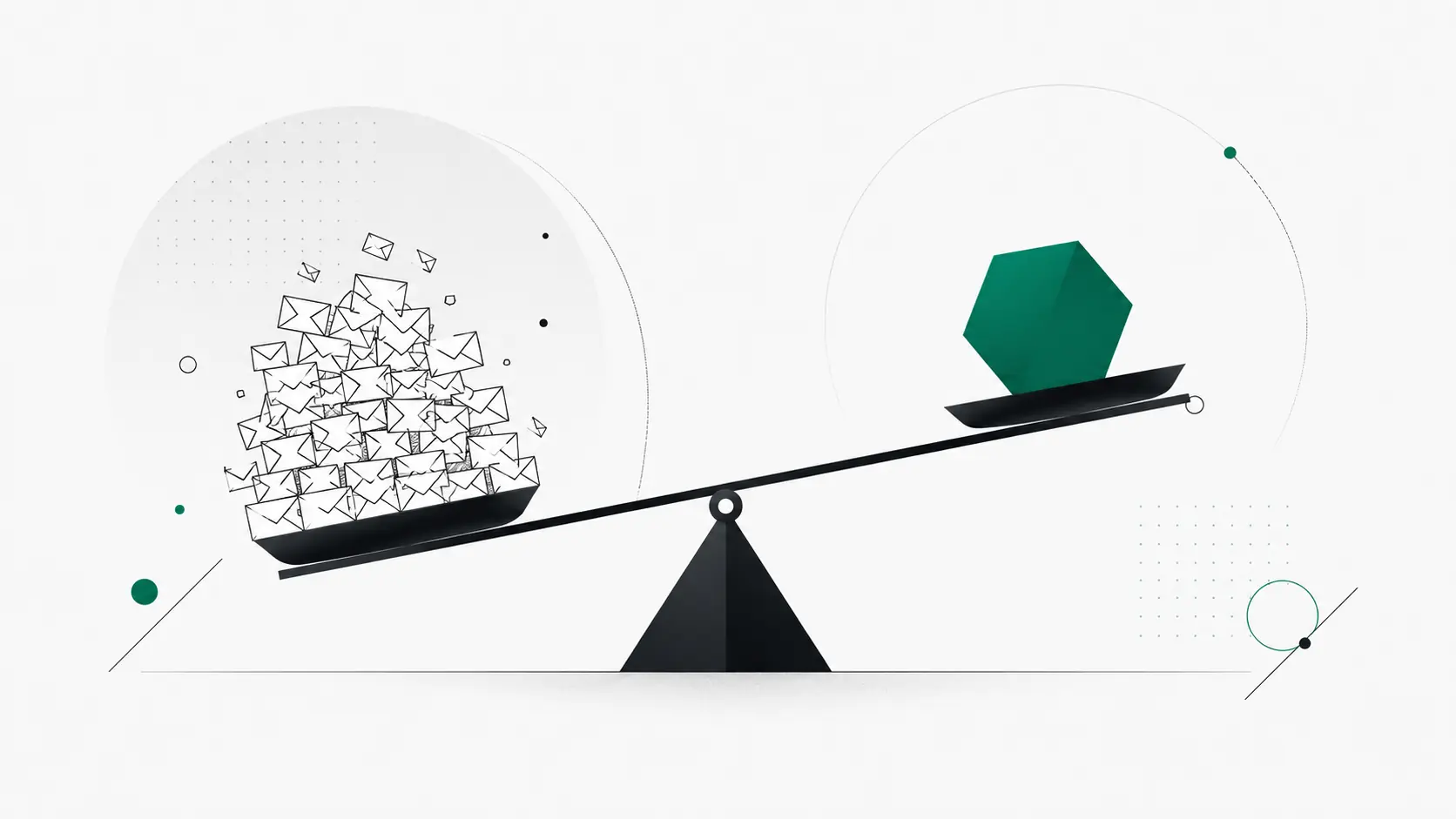
Most SDR teams treat a bad cold email as a missed rep, at worst an annoyed prospect who deletes and moves on. That's the wrong model. Buyers don't forget bad prospecting, they use it to cross vendors off lists before evaluation even starts. According to Gartner's Sales Practice research, 73% of B2B buyers actively avoid suppliers that send irrelevant outreach. That's not a soft brand-perception number, it's a direct pipeline killer, and it happens upstream of anything your sales team can see in a CRM.
Gartner's Robert Blaisdell, VP Analyst in the Sales Practice, put it plainly:
"Many B2B buyers feel overwhelmed and frustrated by the outreach they receive from sellers and the seller's organization. Bad prospecting actively damages relationships with potential customers."
That's worth sitting with. "Damages relationships" isn't marketing language, it's describing an actual, measurable shift in how buyers treat your company going forward, independent of whether your product is good.
Buyers pick vendors before you ever get a meeting
The reason a bad first touch matters so much is that B2B buying has become a confirmation process, not a discovery process. Forrester's 2024 Buyers Journey Survey of 11,352 buyers found that 92% enter evaluation with at least one vendor already in mind, and 41% walk in with a single preferred vendor already decided. Executive buyers lean even harder into pre-formed preference.
That means the outreach you send to a cold prospect isn't pitching into a blank slate, it's competing for a spot on a shortlist that's often already been mentally drafted. TrustRadius's 2024 B2B Buying Disconnect Report found that 78% of buyers who build a shortlist choose products they were already familiar with before starting formal research, rising to 86% among enterprise buyers. Familiarity built before the sales conversation drives the outcome. A cold, generic pitch does the opposite of building that familiarity, it actively burns it.
And the damage isn't abstract. TrustRadius's earlier Buying Disconnect research found cold calls (64%) and sales emails (32%) are buyers' top-named reasons for avoiding a vendor altogether. Megan Headley, VP of Research at TrustRadius, described the disconnect directly:
"We see vendors continuing with tactics such as cold sales outreach, while buyers are increasingly turned off by these approaches. Instead, buyers are seeking self-service channels, and even crossing vendors who don't support that need off their consideration list."
The volume problem is a math problem, and it's getting worse
Part of why outreach quality has degraded is simple: the cost of sending has collapsed while the target inbox pool hasn't grown. First-party operating data shared by SaaStr founder Jason Lemkin shows a single deployed AI SDR now sends roughly 3,221 cold emails a month, compared to 75-285 a month historically for a human rep, an 11x to 40x volume increase per seat, all aimed at the same finite set of buyer attention.
That volume surge shows up in the spam layer too. A joint study by Barracuda Networks, Columbia University, and the University of Chicago found that by April 2025, AI-generated messages made up 51% of all global spam email, the first time AI-authored spam overtook human-authored spam. Buyers aren't imagining the flood. It's real, it's measurable, and it's landing in the same inboxes your legitimate outreach needs to clear.
There's also a documented psychological cost to outreach that reads as machine-written. Research by Kirk and Givi, published in the Journal of Business Research, ran seven preregistered experiments and found that simply believing a message was AI-authored reduced perceived authenticity and triggered what the researchers termed "moral disgust," independent of whether the copy itself was any good. The label "AI-generated" does damage on its own, before a buyer even evaluates the content.
Consistency matters as much as volume
Gartner's same research found that 69% of B2B buyers notice inconsistencies between what a vendor's website says and what its reps claim in outreach. That gap reads as dishonesty, not overzealous marketing, and it compounds the trust problem outbound already has. When outreach exaggerates, overpromises, or contradicts what a buyer can verify independently, it doesn't just fail to convert, it actively confirms the buyer's suspicion that the vendor isn't worth engaging with at all.
This lines up with a broader channel-preference shift. A 2026 survey of B2B SaaS CMOs by Wynter found 42% rank word-of-mouth as the single most effective channel for getting a vendor into consideration, while cold outreach ties with paid ads at just 2%. Buyers trust what peers tell them and what they can verify themselves far more than what a stranger emails them cold.
What this actually means for GTM teams
The fix isn't "stop doing outbound." It's treating every cold send as a brand impression with lasting consequences, not a disposable attempt at a reply. A few things follow directly from the data above:
- Assume every send is being judged against your website and your public claims. Inconsistency between the two is now something 69% of buyers explicitly notice.
- Assume a bad first touch doesn't just fail, it removes you from a shortlist that gets locked in well before active evaluation starts.
- Assume volume for its own sake is working against you. More sends into a saturated, AI-slop-filled inbox pool doesn't create demand, it just adds to the noise buyers are actively filtering out.
- Treat generic, unverified, or exaggerated claims as a liability, not a shortcut. Buyers who can fact-check you in two clicks will.
None of this means outbound is dead, it means the bar for what counts as an acceptable send has gone up while the cost of getting it wrong has gone up right alongside it. Before a message goes out to a prospect who may never give you a second chance, it's worth having something other than gut feel check whether it reads as relevant, consistent with your public claims, and worth a reply rather than a delete.